Tuesday, 26 November 2013

Promo. Far Beyond Rubies by Rosemary Morris


I am delighted to announce that my e-book, Far Beyond Rubies by Rosemary Morris, has been published as a paperback and an e-book.


“When Gervaise first sees Juliana he recognises her, but not from this lifetime, and knows he will always protect her.”

 
Set in 1706 in England during Queen Anne Stuart’s reign, Far Beyond Rubies begins when William, Baron Kemp, Juliana’s half-brother, claims she and her young sister, Henrietta, are bastards. Spirited Juliana is determined to prove the allegation is false, and that she is the rightful heiress to Riverside, a great estate.

 
On his way to deliver a letter to William, Gervaise Seymour sees Juliana for the first time in the grounds of her family home. The sight of her draws him back to India. When “her form changed to one he knew intimately—but not in this lifetime,” Gervaise knows he would do everything in his power to protect her.

 
Although Juliana and Gervaise are attracted to each other, they have not been formally introduced and assume they will never meet again. However, when Juliana flees from home, and is on her way to London, she encounters quixotic Gervaise at an inn. Circumstances force Juliana to accept his kind help. After Juliana’s life becomes irrevocably tangled with his, she discovers all is not as it seems. Yet, she cannot believe ill of him for, despite his exotic background, he behaves with scrupulous propriety, while trying to help her find evidence to prove she and her sister are legitima


Reviews.


J. Pitman’s 5 out of 5* review of Far Beyond Rubies by Rosemary Morris.

 
It was great to see that there's a new Rosemary Morris out. I like her exquisite attention to detail, and she writes in the reign of Queen Anne, which is something a bit different from the usual Regency romance.

 
In this new book, which I have to admit I raced through and will now read again, the heroine Juliana is stunned to discover that, according to her half-brother William, she and her sister are bastards. The tale of how Gervaise Seymour helps her, how she helps herself, her sister and her various strays is quite enchanting. Rosemary uses her knowledge of India, very pertinent in this period, to bring a spice of something different to this novel. Her 'tanned hero' is no pallid, painted Englishman but one who has travelled, married and been widowed on that exotic continent, thus earning himself the nickname 'Beau Hindu' amongst the fashionable in London.

 
This novel is not a light book, as it contains research into the politics, religion and morality of the reign of Queen Anne. However the research informs the novel quite naturally and I found this to be a lovely, sparkling romance. It is somewhat in the style of the late Georgette Heyer, although I think after four novels Rosemary Morris is developing a voice of her own.  

 
Suitable for those who like a cracking good historical romance, set in England, well researched, sensual but no explicit sex.


* * * *

Carolin Walz 5* Review of Far Beyond Rubies by Rosemary Morris.

 
Picked up Rosemary Morris' novel recently with the expectation of a nice escape into romance, and was agreeably surprised by the wealth of historical detail and engaging characters. The heroine, Juliana, is suitably persecuted by an evil step-brother and later on by a libertine suitor, and the hero, Gervaise, is not only handsome, but also mysterious, coming from a somewhat broken family and having been previously married to a woman in India. That is one of the things that sets this tale apart from the usual run of historical romances. The author is obviously quite familiar with India, and the reader gets all kinds of interesting tidbits about life there, from certain dishes Gervaise springs on his friends to what he has learned about the country's belief systems, the latter of which at first causes quite some conflict between him and the heroine. The resolution is believable and satisfying. Well-written throughout.


* * * *

 
Far Beyond Rubies is available from:


         www.rosemarymorris.co.uk


          Previous novels.

 Tangled Love

Sunday’s Child

False Pretences

New Release February, 2014 The Captain and The Countess

Sunday, 24 November 2013

A GIFT FROM THE STARS by Linda Banche

My latest Regency romance, A Gift from the Stars, is now available.

A Gift from the Stars , Book 1 of The Regency Star Travelers, is a sweet, traditional Regency romance with science fiction elements, 71,000 words. a clean read.

The Regency Star Travelers--Where the Regency and outer space meet with romance.

BLURB:
A gift from the stars can change your life.

Miss Elizabeth Ashby loves astronomy. She especially enjoys her once-in-a-lifetime chance to observe the Great Comet of 1811. However, her excitement vanishes the night an odd-looking meteor proves to be a sky craft which lands nearby. The man who emerges from the vehicle doesn’t see her, but as he reenters his craft to fly away, he drops a small red stone.

The stone from the stars glows and sends waves of warmth and something else through Elizabeth. Her incipient cold disappears, her illness-prone mother shakes off her maladies, and everyone else who comes near the stone, which Elizabeth wears as a pendant, feels in the pink of health.

Including Mr. Jonathan Markham, who also saw the strange meteor but was too far away to determine what the object was. Gored by a bull, Jon has been slow to mend until he meets the enchanting Elizabeth. Does his sudden speedy recovery emanate from his fascination with the desirable lady? Or something else?

A sweet, traditional Regency romance novel with science fiction elements. 71,000 words.

EXCERPT:
Lower and lower the shooting star descended, much too slowly to Elizabeth’s way of thinking. From the angle and rate of its motion, the object would likely strike the earth close by. If she could distinguish some landmarks by its glow, perhaps she could find the stone.

She craned her neck back as the meteor soared across the firmament. The unearthly rock blazed with the colors of the rainbow from friction with the air.

Coldness pricked her spine. A meteor that enormous should race through the heavens, shrieking in outrage as its surface pounded through the atmosphere. This one was silent. And the stone—or was it a stone?—sloped down in a leisurely, graceful curve, as gently as a feather floating in a light breeze.

With eerie stillness, the object continued its glide across the ebony sky, looming ever immense as its bulk neared the ground.

She could even make out features. In her experience, meteors were dark, pitted lumps of rock or metal. This one was white, its pointed nose flaring out behind to form a stretched-out triangle, almost like a bird with unfurled wings.

And its size! Her heart in her throat, she jumped up. The thing was larger than a mail coach. And it would fall onto Sentinel Moor beside her house!

Continually slowing, the peculiar entity descended. The object slipped below the level of the high Sentinel Oak across the field, and then behind the top of the six-foot hawthorn hedge separating her garden from the meadow.

Elizabeth took a step to run around the tall shrub. Blinding whiteness exploded on the moor. She threw up her hands to shield her eyes and then tumbled to the ground.

Available at Amazon, Amazon UK, Barnes and Noble and Smashwords. Coming soon to Apple, Kobo and Sony. Note, all formats are available on Smashwords.

Thank you all,
Linda
Linda Banche
http://www.lindabanche.com

Wednesday, 13 November 2013

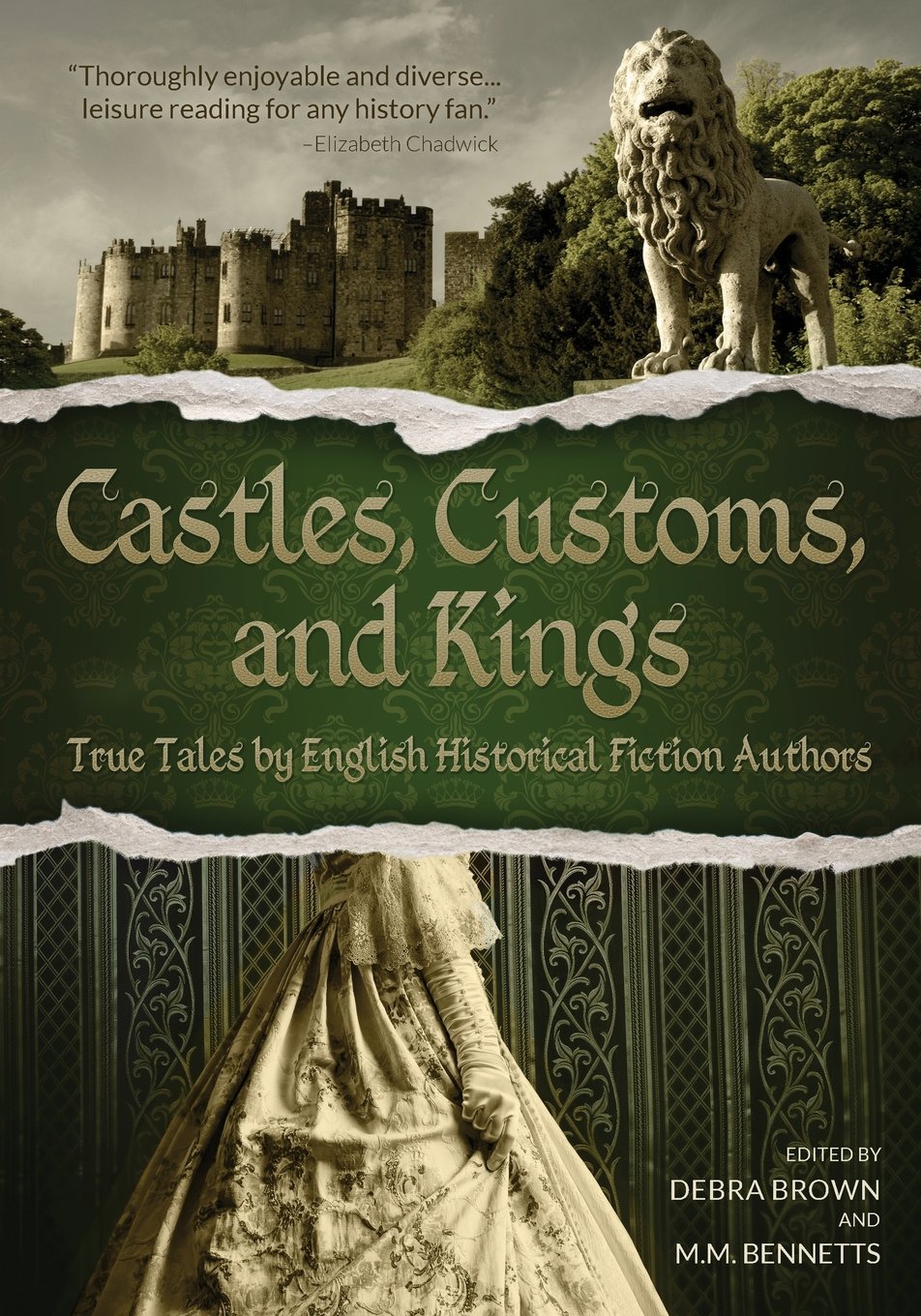
Deborah Brown and M. M. Bennetts: Castles, Customs and Kings

The following excerpts are taken from Castles, Customs, and Kings: True Tales by English Historical Fiction Authors. The book is an anthology of select, fascinating posts from the first year of the English Historical Fiction Authors blog with historical tidbits from fifty-five authors gleaned from the research they did in writing their novels.

Secret Service, Spies, and Underhanded Dealings during the 17th Century
BY KATHERINE PYM
As historian Violet Barbour wrote in the biography, Henry Bennet, Earl of Arlington (published 1914), “The ministers of Charles II were not chosen for their honesty…”
This did not make Charles II a stupid man, but one who had gone through years of hardship. His life had often been in peril. Men conspired against him or tried to rule him. This left its mark. To watch for underhanded dealings during his reign, he sought out men who would meet toe-to-toe those who threatened the king and his court.
On the one hand, Charles II filled his court with frivolity. He played, danced, and allowed his spaniel dogs to soil the palace. He and his brother, the Duke of York, loved the theatre, and supported their own troupes. Charles II allowed women on stage.
On the other hand, Charles II inherited a land filled with restless and bitter malcontents whose very existence had shattered at the fall of the Commonwealth. Rarely opening up to anyone, Charles did not trust easily. He expected attempts on his life or efforts to overthrow his monarchy.
During the rule of Cromwell, John Thurloe was the head of espionage. As Secretary of State under Cromwell, he sent out spies to cull the plots from within the Protectorate’s government. His spy network was extensive. He also employed men—and women—who were, on the surface, stalwart royalists. His spies could be located in every English county, overseas (i.e., in Charles II’s exiled court), in the Americas, and the far Indies.
Thurloe compiled lists, sent spies into enemy camps, and had men tortured and killed. One such fellow, Samuel Morland, an assistant to Thurloe under Cromwell, confessed to having witnessed a man being “trepanned to death” at Thurloe’s word. (A trepan, according to Dictionary.com was “a tool for cutting shallow holes by removing a core.”) Not a nice way to go.
Thurloe orchestrated the Sir Richard Willis Plot, wherein the king and duke were intended to be lured out of exile to a meeting on the Sussex coast. Once the brothers disembarked, they would be instantly murdered. Thankfully, we know this plot failed.
Commonwealth spies infiltrated homes, churches, and businesses to destroy the enemy, and under Charles II’s rule, his government did the same. Their goal was to destroy nonconformists, or “fanaticks”. Depending on who was in power, plots were a part of political life.
After the Restoration, Thurloe was dismissed, but not executed, for crimes against the monarchy. He was released in exchange for valuable Commonwealth government documents.
During the king’s exile, Sir Edward Nicholas held the position of Secretary of State, but he was old, nearly age 70. Within two years of the Restoration, Charles II replaced him with Sir Henry Bennet, who took charge of the Crown’s espionage.
Joseph Williamson worked for Bennet as the undersecretary. Williamson was born for this work. He took the bull by the horns and enhanced the processes Thurloe had begun. Williamson built a brilliant spy network. He enlisted informers who, for money, turned on their associates. He used grocers, doctors, and surgeons, anyone who would inform him of persons against the king. Informants were everywhere. He obtained ambassadorial letters and had them opened and searched for underhanded deceit. He had men overseas watching for any plots.
His tools were numerous. He loved ciphers and cipher keys. Doctor John Wallis was an expert in this who worked under both Thurloe and Bennet. The man could crack a code in nothing flat.
Williamson, known as Mr. Lee in the underworld, used London’s Grand Letter Office for ciphered messages to pass back and forth between the undersecretary’s office and his informants and spies. He expected to be kept apprised by ciphered letters, passed through the post office, at the end of each day.
Under Thurloe’s stint as Secretary of State during the Commonwealth, the secret service received £800 per year. Under Bennet, the money doubled. Most of the annual budget was spent on spies and keeping them alive.
For more reading on spies and espionage during the reign of King Charles II, see my novel Of Carrion Feathers which is set in London, 1662.


Seven Years’ Hard Labor Overseas: Transportation as Punishment in the 17th-19th Centuries
Steal a Book BY J.A. BEARD
England, like many societies throughout history, has had to struggle with what to do with its criminal population. For a good chunk of English history, punishment was harsh and severe. Executions were common for a number of offenses. The fundamental question of how justice is best served has been explored throughout English history and influenced by shifts in historical, philosophical, and religious beliefs.
With the expansion of British colonial holdings in the 17th century, another option arose: transportation. The idea was simple in concept if occasionally more complicated in execution. Transportation at its core was exile. Instead of local imprisonment, execution, or another punishment, an offender was sent to a distant overseas holding. In this way the home country depleted its criminal population and minimized the resource impact of a growing criminal population.
Transportation was not reserved for the most heinous of offenses such as murder. A variety of crimes, both major and relatively minor, could end up with a criminal being sentenced to transportation. For example, in 1723, one man was sentenced to transportation and an accompanying seven years of labor for stealing a book.
Initially, many criminals were transported to colonies in continental North America and the West Indies. The American Revolution complicated things and ended North America as a popular choice for transportation even for non-rebellious areas. By 1787, British transportation was focused instead on Australia and some other smaller colonial holdings.
Transportation may have been exile at its core, but it was also supposed to serve the needs of the home country beyond that. In addition to the restrictions one might expect, such as the death penalty for those returning from transportation, these sentences typically carried with them a hefty labor requirement. The services expected from the convicts might be directed toward what we’d now call public works projects, or the convicts might end up as indentured servants to free citizens in a colony.
As one might expect, sending people thousands of miles away and never allowing them to return home was going to predispose them to even more anti-social behavior than whatever got them in trouble initially. If they had no hope of any sort of normal life, it would only contribute to the kind of instability and revolts one witnessed with completely enslaved populations. One way of combating this, and also serving the general idea of some form of semi-merciful justice, was to limit the main criminal penalty period to a defined number of years. After the prisoners served their sentences, they would not typically regain all of their rights, but, at minimum, would have enough that they could live a semi-normal life.
Related to the exile of general criminals, a variation on transportation was also used to sell people directly into slavery. Though your standard-issue English criminal probably would end up an indentured servant on a plantation or digging a canal or what not, hundreds of thousands of Irish and Scottish political and war prisoners taken during the 17th century ended up being sold into slavery in the West Indies and this, in some cases, continued in some forms even until nearly the end of the 18th century. Please note that in most cases these were, for all intents and purposes, true slaves and not simple indentured servants.
The interbreeding of Irish and African slaves (who were initially considerably more expensive than Irish slaves) in the West Indies became so extensive that by the end of the 17th century, specific laws were passed to prohibit it. Admittedly, the issue with the Irish and Scottish was more an offshoot of war (and rebellion) between England, Scotland, and Ireland, and even many of the laws concerning their handling were distinct from the various transportation acts passed to cover non-political/war-offenses.
Given our modern view of a more rehabilitative justice system, transportation may seem cruel. Indeed, even being a child did not necessarily protect one from a transportation sentence, though age and size (tiny laborers aren’t efficient, after all) were somewhat taken into account. There are, however, documented cases of children as young as seven years old being transported to Australia. It is important to keep in mind, though, that by the standards of the time, transportation was often considered somewhat more lenient than the more common punishments: execution or being sentenced to a disgusting and overcrowded prison on land.
Then, as now, the building of more prisons to give convicted criminals more space wasn’t high on the list of societal priorities. In addition, the general English (or general world) attitude toward punishment from the 17th through 19th centuries could more generally be defined as retribution-based rather than rehabilitation-centered. There were such severe issues with prison space that even more disgusting and overcrowded prison ships were used as supplements.
That being said, it’s hard not to notice the national self-interest served by thousands upon thousands of cheap laborers being available to help develop new colonies. Transportation would linger, as a punishment, officially until 1868, but for several reasons, including socio-economic and geopolitical changes, it had de facto ended years before.


Castles, Customs, and Kings is available at Amazon US, Amazon UK, Barnes and Noble, and Kobo. It is an excellent gift for lovers of history and with its short topics, a great book for a waiting-room or break-room. Author Tom Williams said, "It's an amusing trot through British history and excellent bedtime reading."

M.M. Bennetts is a specialist in the early 19th Century. She is the author of May 1812 and Of Honest Fame.

Wednesday, 30 October 2013

Competition: Far Beyond Rubies

Today to celebrate the publication of the paperback of Far Beyond Rubies I am offering the first and last entrants a copy of the novel.

To enter answer the following questions, the answers to which are at www.amazon.co.uk or www.amazon.com

Q. In which year is Far Beyond Rubies set?

Q. To which country is Gervaise drawn when he first sees Juliana?

Q. What do Gervaise and Juliana want to prove?

Q. What are the titles of Rosemary Morris's other published novels?

Send the answers to: rosemarymorris@hotmail.co.uk  and include your name. Subject. Competition. Far Beyond Rubies

Competition ends on Saturday, 2nd November.

Prize Winners announced on Sunday, 3rd November

The prize winners will be notified by e-mail

Wednesday, 23 October 2013

A Divided Inheritance by Deborah Swift


Releasing in Paperback tomorrow, out on Kindle now!
'There is everything to admire in this novel - the crisp writing, the fully-realized characters -- but it's Swift's sensitive and vivid portrayal of the Moriscos that especially sets this novel apart. A Divided Inheritance achieves what all stellar historical fiction must: through the voices of imagined characters, important lessons from the past linger and haunt long after the book is finished.' 
Langum Prize winner Ann Weisgarber
EXTRACT from Chapter 2

After an hour they were back at West View House, unlacing
muddy boots in the hall. Elspet hung up her cloak, and heard the
door creak open behind her. She paid it no mind, accustomed as
she was to the servants coming and going with coals for the grate.
But a hand on her shoulder made her swivel round, startled.
‘Father!’
He was never back from work this early. From the corner of her
eye she saw Martha dip a ragged curtsey, both dogs were growling
and barking and pulling at her.
‘What a din,’ Father said. ‘Martha, take those wretched dogs
out the back, to the stables.’
Martha bobbed and pulled the dogs away. Elspet heard Jakes
barking all the way to the back door.
‘Elspet, may I introduce your cousin, Zachary Deane.’ It was
only then that she saw him, the stranger hanging slightly back in
the doorway, his eyes casting quick, sidelong glances about the hall.
‘Oh,’ she said, pulling off her muddy gloves in haste and putting
them aside. ‘I wondered what was the matter with the dogs.’
‘You’re too soft with them,’ her father reproached.
‘They look like fine animals,’ Zachary, the young man, said. He
placed one hand on his sword as he made a small bow.
Father’s fingers pulled nervously at the edge of his robe. The
newcomer was still bent over and she saw his hair was tangled and
damp with perspiration. He swung back to upright with a brisk
wave of his hat.
Father nodded to her to prompt a response.
‘Oh – your servant,’ she murmured, dipping her head first to
the newcomer, and then to her father, ‘Forgive me, Father, you
caught me by surprise.’
She tried to catch the young man’s eye and smile, but he glanced
away, finding something of interest in the yard.
‘Zachary is my sister’s boy,’ Father said in a rush. ‘But Magda—
’, he broke off. ‘I mean to say, Zachary’s mother and I have been
estranged for some years. Unfortunately, she has passed away.’
Zachary smiled thinly at Father, his lips compressed, and then
looked at the ground.
‘I did not know she was gone,’ Father said, ‘and Zachary and I
have only just found each other.’
‘My condolences, Cousin.’ Elspet’s first impression was that
Zachary did not look like a man in mourning – not wearing that
shoddy rust-coloured doublet and cloak worn to grey at the hem.
She wondered if he was ill-fed; his hose sagged at the ankles.
‘With his mother gone, it is right and fitting we do our duty and
look to our own,’ Father said. ‘Zachary will lodge in the lower
chambers, and I know you will make him welcome.’
In the distance Diver was yapping. Elspet gathered herself. She
regretted not being warmer or more welcoming, especially as her
cousin had been bereaved. He must think her lacking in courtesy.
She smoothed her ruffled hair and said, ‘What a terrible thing. I am
so sorry to hear of your loss, I hope you will feel at home here.’
Father turned to him. ‘The lower chambers are not much, but —’
‘They will be better than I am used to, I’m sure,’ Zachary interrupted
him. ‘Do not go to any trouble on my account.’ His voice
was pleasant and neutral, though his eyes darted restlessly round
the hall.
Father patted him on the arm sympathetically. An unusual gesture,
for he was never much given to outward shows of affection.
He must be trying hard, Elspet thought.
‘Good.’ Father exhaled a long sigh. ‘I’ll take Zachary down,
and Coleman will help him fetch his trunk from the carriage.’
‘No need,’ Zachary said. ‘It’s paltry few things. I can do it
myself.’
‘Coleman will assist you. No point having servants else.’
Zachary was about to speak but then closed his mouth. Instead
he gave a curt nod. He cast Elspet a long appraising look before
turning and going back out of the door.
When he was out of earshot, Father said, ‘You will grow to like
him, I know you will.’
‘I like him already.’
‘No you don’t. It is written clear as clear on your face. You
looked him up and down as though he were a servant you were
about to hire.’
Indignation rose up in her. Father had described exactly the way
Zachary had looked at her.

www.deborahswift.com


Sunday, 13 October 2013

A Colourful Death now in PAPERBACK

by Carola Dunn

A COLOURFUL DEATH is the second in my Cornish Mystery series. Cornwall is a peninsula bounded by the Atlantic Ocean on the northwest. The coast is indented with rocky, cliff-bound coves providing harbours over the centuries for fishermen and smugglers alike. Much of the centre consists of rugged Bodmin Moor, but the moors are surrounded by fertile farmland with a milder climate than most of Britain.

Large print edition


With small towns, built of local granite and roofed with local slate, and picturesque scenery, Cornwall has long been a haunt of holiday-makers--and artists.


One such painter, Nick Gresham, is next-door neighbour to my protagonist, Eleanor Trewynn, a widow in her 60s. Thanks to an introduction from Eleanor, Nick succeeds in placing a couple of paintings in a London art gallery. He returns triumphant from London only to find the pictures in his shop have been slashed to ribbons.

US edition, hardcover and paperback

Sure that he knows who the culprit is--a jealous fellow-painter--Nick sets out to confront him. Eleanor, worried about what he might do, tags along, with her Westie, Teazle, in tow.

Excerpt:


"There it is." Nick pointed to a narrow shop front opposite the Gold Bezant Inn.

It took Eleanor a moment to decipher the sign above the shop window, as it was written in Old English script. King Arthur's Gallery, it said.

"King Arthur? Shouldn't that be in Tintagel?"

"He couldn't find a suitable place in Tintagel, but he's obsessed with King Arthur. Come and look."

In the window was a display of three paintings. At first glance, they seemed to Eleanor to be quite pretty but rather depressing. She could understand why holiday-makers didn't choose to buy pictures of slender mediaeval maidens with flowing hair and tragic mouths drooping over dead or dying knights, however meticulously portrayed. She wouldn't want one on her wall, breathing gloom every time she looked at it. They were flamboyantly signed: Geoffroie Monmouth.

But she didn't have time to study them. Nick had pressed the electric bell button. No one came. Heedless of the CLOSED sign, he pushed the door. Opening, it set off a jangle, just like his own shop door. The fact that it was not locked suggested to Eleanor that the artist was still within, probably in the throes of producing another grim memento mori. She tied Teazle's string to an ancient, worn boot-scraper to one side of the door and hurried after Nick.

The blind at the rear of the display window was pulled down, so the interior of the shop was dim. Facing the door, a life-size and remarkably lifelike King Arthur stood, barring the way. Grey-bearded, he wore a crown encircling his helmet, and his visible arm and his legs were clad in gleaming armour, the rest covered by a crimson tabard embroidered with flowers. In his right hand he wielded Excalibur. His other arm was hidden by a blue shield with a device of three crowns. Exquisitely detailed flowers surrounded his mailed feet.

Though Eleanor was sure she had never seen the picture before, it was vaguely familiar.

The jangle failed to bring any response. Nick looked around. "Damn," he swore under his breath. "If he's not in the back room, I'll have to trek up to his bungalow."

"Not a bungalow, surely! He ought to live in an ancient cottage overgrown with rambling roses, if he can't manage a crumbling castle."

"A 1950s bungalow," Nick said firmly, striding round behind King Arthur. "And any interest he has in flowers he devotes to his painting, not his garden."

Reluctantly Eleanor followed. He flung open a door in the back wall and stepped through into a room lit by a window facing north, high in the far wall.

"Ye gods! Eleanor, don't come in!"

But Eleanor was already on the threshold. She saw a figure sprawled face down on the bare boards. His beige smock was drenched with crimson, and a crimson pool had spread across the floor around him.

Someone pushed past her and cried in an anguished voice, "My God, Nick, what have you done? You've stabbed him!"


So Nick is arrested, and it's up to Eleanor to find out who really killed Geoffrey Monmouth. She soon finds out there are many people who would have liked to...

UK edition


Seattle Mystery Bookshop
Mysterious Galaxy
http://www.amazon.co.uk/Colourful-Death-Cornish-Mystery/
http://www.amazon.com/Colourful-Death-Cornish-Mystery-Mysteries
Barnes&Noble
Waterstones

Tintagel--Old Post Office


Padstow--scene of the crime


A shop in Port Isaac. Eleanor and Nick live in a fictional village based on Port Isaac and Boscastle, farther up the North Coast.

The popular TV series Doc Martin is set in Port Isaac.

Wednesday, 2 October 2013

Marry a smuggler?

Smuggling was rife in the eighteenth and well into the nineteenth century among the small hamlets and remote farms of Northumberland. This surprised me when I researched the history of the area in which I wanted to place my heroine, Melanie Grey, and I decided to incorporate such activities into her story. She seemed just the right sort of person to be able to live with such risks, though she tried to persuade the master of Gavington to mend his ways for the sake of his child if not for himself. I've given you the opening lines of the story here, and to find out what happens you'll have to read on...


‘Gavington House, Miss.’
The coachman, no doubt anxious to reach his journey’s end before dark, was briskly polite as he drew the coach to a halt on the road between Corbridge and Morpeth. Descending unaided and with some difficulty, given her hooped skirt, she saw he had deposited her bag beside the imposing stone pillars of an open gateway. He tipped his hat to her and sprang back up to his perch with a cry to his horses. She watched the coach roll along the lane, and waved away the cloud of dust and grit that flew up behind the large wheels.
Green hedgerows divided greener fields, and there was not a dwelling in sight. Looking around, Melanie shivered. The snarling griffins with claws dug into the top of the stone gateposts added to her feeling of unease. Stepping closer, she realised the griffins protected a date incised into the stone beneath them: 1524. Gavington House had stood here for three hundred and forty years.

A little unnerved by such a span of time, Melanie stooped, gripped the handles of her portmanteau and marched between the gate posts with a determined stride. The gates had been opened and then abandoned some time ago, for tall weeds grew on both sides of them. Odd, she thought, as she walked along the weedy gravel drive that led through a shadowy clump of pine trees. Though she had packed only the necessities and a fresh gown for tomorrow’s interview, her leather bag was heavy and the gravel drive did not make for easy walking. Full of shallow gradients and curves, it wound through the trees in a most annoying way. Now and then, through gaps in the foliage, she caught sight of what must be Gavington House.

Had she been in the comfort of a sprung carriage, she would have found the approach charming and no doubt been delighted with each pretty vista as it appeared. But after twenty minutes of energetic walking, Melanie hesitated. The drive was about to take one of its unnecessary bends away from the house, which was plainly visible two hundred yards away in the opposite direction.


With a frustrated sigh, Melanie gripped her bag firmly, brushed through the low hanging branches and strode out across the lawn. If she were shot for it, she would not follow that drive an instant longer. Hurrying across the open stretch of recently scythed grass, she glanced over her shoulder, half expecting an irate gardener or gamekeeper to chase her off the hallowed turf.

Available here:  amzn.to/ZLEeT1

“Fascinating and beautifully created characters, plenty of secrets, and a compelling love story between a hero and a heroine that tugs at your heart strings, makes this a must read.”