Here's an excerpt from my mainstream historical novel,
Blue Gold. This is set in ancient Egypt during the Hyskos period.
Excerpt
It was the hour of midday, a holy time throughout the Two Lands. Within the inner sanctuaries of the temples of Ptah and Amun, Ramose and Sekenenre attended their gods.
Ramose, standing alone in the windowless stone cell at the center of the great temple complex of Memphis, lifted the arm-shaped censer and lit the incense he was offering to Ptah. As the costly myrrh, frankincense and other perfumes burned, their colored flames casting strange, lifelike shadows over the wooden statue of the god in his golden shrine, Ramose began to sing. His deep voice filled the dark chamber.
“Ptah! Maker of the flood, of the green crops. Dweller-in-the-Duat, hear the prayer of your king, Aweserre. Let not my people starve, Ptah. Let my people go free, Ptah, free of hunger and free of fear....” The song went on for many verses, rich in magical formulae to please the god, to make him wish to help, to make him obey Aweserre.
In Thebes, in the temple of Amun, Sekenenre was invoking exactly the same spells to his god. His voice was not as good, and he sweetened his requests with an offering of honey.
“Let all the workshops prosper, Ptah....”
“Give strength to my army, Amun....”
“Be merciful to the people, Ptah....”
“Let me vanquish the false usurper, Aweserre....”
The small gilded figures within their shrines seemed to shift slightly. At first both men thought it was a merely a trick of the lamplight, but then at Memphis and at Thebes, the statues of Ptah and Amun each raised their right arms.
In two separate chambers, hundreds of leagues apart, there was an explosion of light, a swirling, moving array of colors that were emanating from and centered on the two sacred statues.
Out of the flashing vortex in Ptah’s shrine at Memphis, Ramose felt a voice. It spoke not to his ear but directly to his heart, saying his name. The priest dropped his censer and stepped forward. “Here I am, Lord.” He was afraid, yet also exultant. Never before had Ptah spoken to him so directly.
Come, look upon me more closely.
Resisting the impulse to step over the beams of luminous color, Ramose walked into the glowing ball of light. His skin turned red and green, like the waters of a good Nile inundation. His mind was both enlivened and yet at peace.
His reaching hands touched an animal’s muzzle somewhere above the head of the statue: thick hair as bristling as a pig’s, a long snout which was neither that of a bird nor a dog but somehow both. The priest cried out and hastily withdrew his fingers.
Good, you can still feel surprise. You will need that wonder of the new and of the old made new where you are going.
Ramose sucked the tips of his fingers, they had begun to smart. “Why are you here in Ptah’s sanctuary, Lord Set?”
Above the outlines of the statue, the god’s ghostly head appeared to smile. You are polite, priest. I like that. Your god too is courteous, and he has given me leave to dwell for a brief space within his own likeness.
The lights dimmed and Ramose could see the god more clearly. Set had the body of a tall strong man, the head and tail of a beast. As the priest watched, Set’s dark shape poured itself down into the confines of the shrine. The narrow, grinning animal head wiggled its long ears and then settled and melted into the calm benign features of Ptah. Only the glowing eyes showed that an immortal other than the god of Memphis now inhabited the sanctuary.
Ugh, how does my brother bear these nasty little funeral wrappings? After it had spoken, the statue, in the shape of the mummified Ptah, shook within its shrine. No matter, I shall not be here long.
“What do you wish of me, lord?” asked Ramose uneasily. As a protection, he muttered a hasty charm and touched his own golden pectoral. The lights rasped against his skin.
Find out what I am. You mortals have been worshipping me wrongly forcenturies and I am tired of it. Your forefathers knew me better - seek amongst them for your answers.
“Lord, I shall do as you command.” Ramose crossed his arms reverently across his chest. “Yet the land is suffering famine and drought—”
Nothing to do with me. That’s one of Amun’s tricks. Now, if you do as I bid, I may be able to bend his arm. Or I may bring you rain. I am the god of storms.
Thunder boomed throughout the temple, its iron-winged noise shuddering the deepest foundations. When Ramose lowered his hands from his ears after the final reverberations had died away, a still small voice said to him, Sekenenre is also going to look for me, and if he finds me first—if Sekenenre understands my nature and discovers my true role, I shall give him power over the whole of Egypt.
In a final leaping flash, the god vanished.
* * * *
Set had been in two places at once—easy for a god. He spoke with Ramose and Sekenenre simultaneously.
Where the priest had watched Set emerge from the light, Sekenenre’s meeting with the god was in darkness. The statue of Amun, lifting its right hand, had knocked the oil lamp standing on the shrine onto the floor.
At once all the other lights went out. Sekenenre was pitched onto his knees, and a wailing din of animal cries—squeals of pigs, roars of hippos, howls of jackals—blew round the sanctuary in a mad whirl. The granite base of Amun’s shrine shivered and then cracked from top to bottom.
Mortal, you have offended me.
Sekenenre felt his mind being stretched like a bowstring: he yelled and tried to beat off the invisible hands.
Mortal, you have mocked me.
Sekenenre, clawing into the soft sand of the sanctuary’s sacred earth-mound in his agony, was horrified by this accusation. He wanted to answer that he worshipped Amun above all other gods, but the pain within him was so great that only a single shout burst from his lips. “How?”
You speared my creatures, killed my followers. You have denied me a priest, and you speak my name withloathing. Yet I say to you that the Delta of Egypt lies within my gift, not Amun’s.
Abruptly, like a lid being put back on a bottle, Sekenenre’s suffering and the vile animal calls were stopped. The Pharaoh of Upper Egypt slumped full length on the floor in a hollow silence, gasping in air. He knew whom he was dealing with now. Yet why had Amun not protected him and the shrine from this abomination?
The immortal read his thoughts. Your blue god is with his wife at her own sanctuary— do not look to him.
Sekenenre, biting his lower lip, dragged himself upright. He would meet death on his feet, as a king should. “What do you want?”
Ah, the differences between men, thought Set, listening at the same time to Ramose’s question. “What do you wish of me?” As a god, he was bound to Aweserre through love and tied to Sekenenre by hate. To both he owed something. He saw the lines of the future mapping out from this tiny room, yet could not see exactly where they ended. No one, not even Ra, could do that. Endless beginnings: that was one of the gods’ functions. Once begun, events in the mortal plane were determined by mortals.
It was time to set the two Pharaohs against each other, like pieces on a senet board. Hear me, Sekenenre. I swear by the Duat, the river of the underworld, that if you can understand my question, I will make you ruler over the kingdoms of Egypt and drive the Hyksos into the sea.
Sekenenre stepped forward in the darkness. “Tell me!”
What am I?
“Power …storm…desert…”
Go to the most ancient sacred places. Worship me there. It may be in one of these, you will find the answer.
Even as he spoke, Set was gone.
To read a blurb for this novel, reviews and more excerpts, please go here:
http://www.lindsaytownsend.net/2008/04/blue-gold.html
Lindsay Townsend
www.twitter.com/lindsayromantic
 In my historical romances I write about every season and sometimes include scenes from seasonal celebrations, such as the winter Saturnalia in ancient Rome. Then, as now, drink was an important part of such festivals, but what kinds of drink?

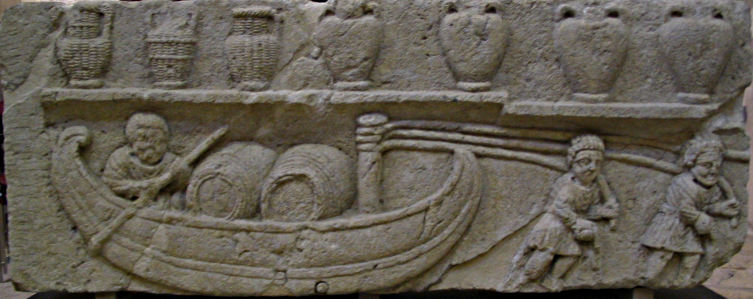 Ancient Romans had a range of beverages to choose from during their mid-winter celebration of the Saturnalia. (December 17th to 23rd.) Romans like L. Lucullus, rich beyond belief after military campaigns in the East, had wine tables at their feasts, huge amphorae containing the wine, long spoons to scoop it out and sieves to strain the lees. Herbs could be added to Roman wine, for colour and flavour, and it was usually diluted with water - boiling water in winter, so the wine could be served warm. There were libations to the gods poured with wine and games played with wine. The Romans enjoyed sweet and dry wines, white, yellow, red and black wines.The black was mature Falernian, which began as a sweet white from grapes picked late, after frost, and darkened as it matured, deepening in flavour over the years (and increasing in price – showy gourmets like Lucullus certainly made a point of serving it).

 A drink common to ancient Roman and northern European lands was mead, made of honey and water. Mead was the drink of choice at Anglo-Saxon feasts. Because drinking water was so often impure in the ancient world, ale was the 'everyday' drink, but mead was for feasting. There were mead halls and, in the halls, mead benches, where men sat drinking side by side. Drinking horns and glasses were richly ornamented and highly prized. Anglo-Saxon wine, some grown from grapes that could flourish in the south of England, was light, quickly consumed and not very strong. Ale, drunk by all ages, was a


